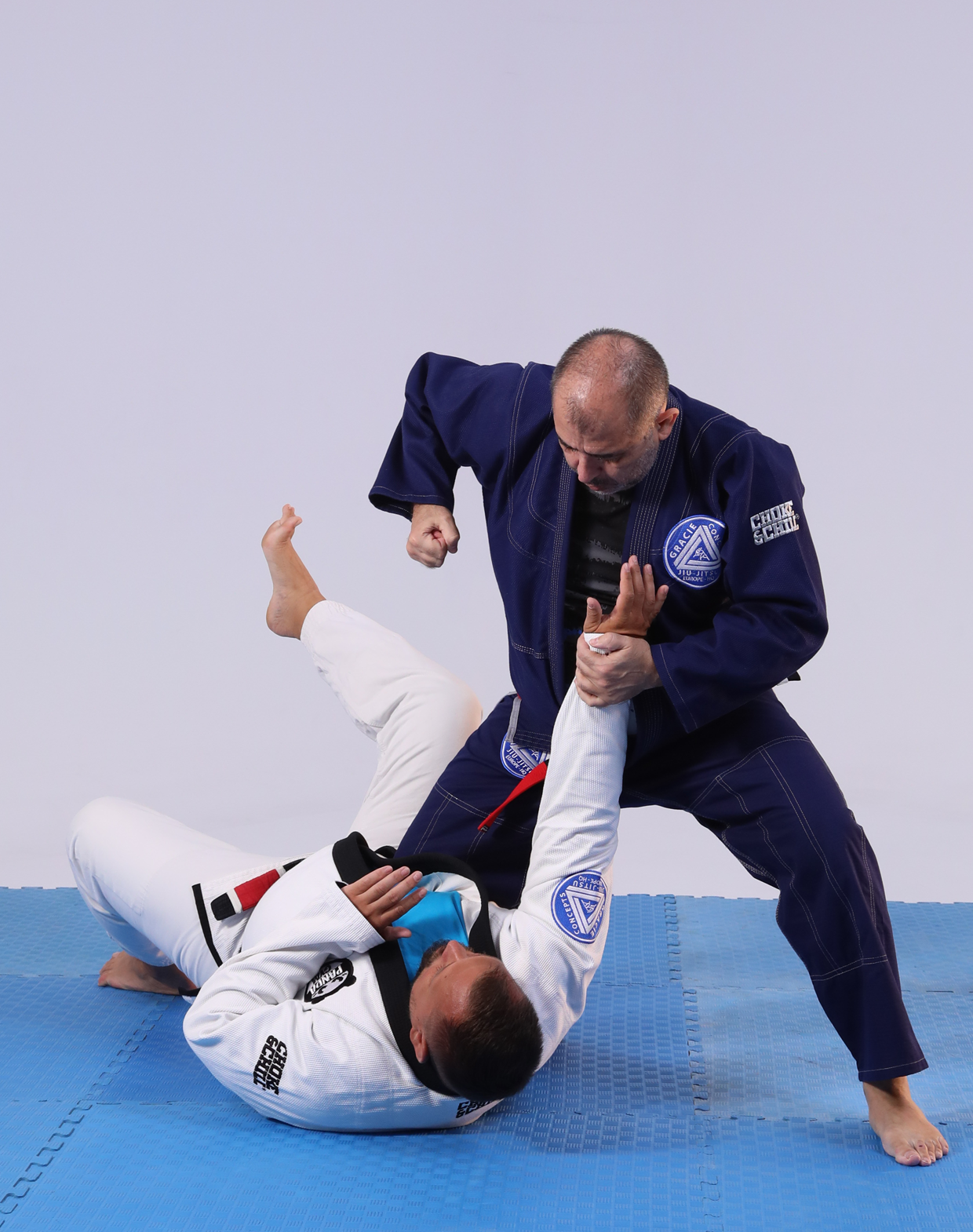
How we train
Depending on the training/study group, some Dojos may focus more (or less) on modern sport BJJ competition style, MMA, Nogi or Self-defense.
Others may use only part of our GJJ program to establish a solid foundation in BJJ; however, they may use different approaches to achieve their group’s goals.
There are many ways to reach Rome! It all starts with the right motivation to walk the path. It may not always be easy or simple, but we guarantee that you and your group will enjoy it.
Je nach Trainings- oder Studiengruppe legen manche Dojos mehr (oder weniger) Wert auf den modernen BJJ-Wettkampfstil, MMA, Nogi oder Selbstverteidigung.
Andere nutzen vielleicht nur einen Teil unseres GJJ-Programms, um eine solide Grundlage im BJJ zu schaffen; sie verfolgen jedoch möglicherweise andere Ansätze, um die Ziele ihrer Gruppe zu erreichen.
Es gibt viele Wege, die nach Rom führen! Alles beginnt mit der richtigen Motivation, diesen Weg zu gehen. Es ist vielleicht nicht immer leicht oder einfach, aber wir garantieren dir, dass du und deine Gruppe Spass daran haben werdet.
Gracie vs. Brazilian Jiu-Jitsu
Train with Prof.
Franco Vacirca, Coral belt
Reserve your spot for one of our seminars or training: The main difference between competitive (Sport) BJJ and Self-defense is not in the techniques themselves, but in the objective and scenario. While competitive BJJ is designed to score points or force an opponent to submit under controlled rules, Self-defense focuses on survival, avoiding injury, and escaping.
Sichere dir deinen Platz für eines unserer Seminare oder Trainings: Der Hauptunterschied zwischen Wettkampf-BJJ (Sport-BJJ) und Selbstverteidigung liegt nicht in den Techniken selbst, sondern im Ziel und im Szenario. Während Sport-BJJ darauf ausgelegt ist, unter kontrollierten Regeln Punkte zu erzielen oder den Gegner zur Aufgabe zu zwingen, konzentriert sich die Selbstverteidigung auf das Überleben, das Vermeiden von Verletzungen und das Entkommen.
Program overview
We are committed to preserving the technical and philosophical standards of Brazilian Jiu-Jitsu. This regulation establishes the official guidelines for all competitions and events sanctioned by the federation, ensuring fairness, safety, and sporting excellence.
Wir setzen uns für die Wahrung der technischen und philosophischen Standards des Brazilian Jiu-Jitsu ein. Diese Regelung legt die offiziellen Richtlinien für alle vom Verband genehmigten Wettkämpfe und Veranstaltungen fest und gewährleistet Fairness, Sicherheit und sportliche Spitzenleistungen.
Age ranges
- Children — 4 to 13 years old
- Youth — 14 to 17 years old
- Adult — 18 to 29 years old
- Master — 30 years or older (Master 1 to 7)
Weight divisions (Gi and No-Gi)
- Rooster — up to 57.5 kg
- Feather — up to 64.0 kg
- Feather — up to 70.0 kg
- Lightweight — up to 76.0 kg
- Medium — up to 82.3 kg
- Light Heavyweight — up to 88.3 kg
- Heavyweight — up to 94.3 kg
- Super-Heavyweight — up to 100.5 kg
- Extremely heavy — over 100.5 kg
- Open Class — Free Weight
The scoring follows the international standard of sport Jiu-Jitsu, requiring control of at least 3 seconds for validation:
- Takedown — 2 points
- Sweep — 2 points
- Knee on belly — 2 points
- Guard change — 3 points
- Mount — 4 points
- Back grip with hooks — 4 points
- Advantages — tiebreaker in case of equal score.
- Finishing touch — immediate victory, regardless of the score.
Illegal techniques by lane
- White and Blue: Heel hooks, reaping (crossing knees), neck twists, and heel hooks are prohibited.
- Purple: heel hook prohibited in Gi; some foot locks allowed in No-Gi.
- Brown and Black Belts: Most leg locks are only allowed in No-Gi; always prohibited in Gi.
- Unsportsmanlike conduct, verbal aggression towards the referee or opponent, results in immediate disqualification.
- Fleeing from combat, intentionally falling into guard outside the valid area, and feigning snapping are punishable by warning or disqualification.
- Kimono (Gi): Standard cotton fabric, white, blue or black colors — no blends.
- Accepted sizes: A0 to A5 (adult), M0 to M4 (child/youth), in good condition and without tears.
- No-Gi: rashguard with at least 10% of the athlete’s belt color and sleeves that extend to the elbow.
- Official Bermuda shorts/shorts without pockets, zippers, or buttons; underwear/lycra underneath is mandatory.
- Belt: color corresponding to the athlete’s official rank, without excessive wear.
All brackets are single elimination, with a repechage for the bronze medal match. Fight times:
- Children’s — 3 minutes
- Youth — 4 minutes
- Adult White and Blue — 5 minutes
- Adult Purple — 6 minutes
- Adult Brown — 7 minutes
- Adult Black — 10 minutes
 VACIRCA BROTHERS BJJ - GRACIE CONCEPTS® HQ